Explore our core technological tools customized for West Coast ports, providing real-time tracking, risk mitigation, and automated logistics management for modern global supply chains.

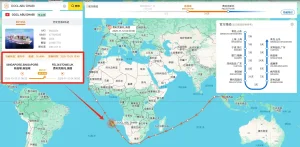
The San Francisco Bay Area—anchored by the Port of Oakland, the Port of San Francisco, and San Francisco International Airport (SFO)—serves as a primary gateway for transpacific trade corridors.
While Silicon Valley drives global technology hardware and software developments, the physical supply chain relies heavily on Northern California's maritime and air infrastructure. Importers and exporters operating in the San Francisco market navigate a highly complex logistics environment. Congestion at terminal gates, chassis shortages, unpredictable inland rail delays, and volatile dwell times at the Port of Oakland present persistent operational risks.
In this high-stakes landscape, static shipping reports are no longer sufficient. Companies require continuous tracking intelligence to manage demurrage, detention, and warehouse staffing. By utilizing advanced shipment tracking services, enterprises can convert raw carrier milestones into actionable business intelligence, keeping their supply chains resilient and responsive.
Global supply chains are undergoing structural transformations, moving from "Just-in-Time" to "Just-in-Case" contingency modeling.
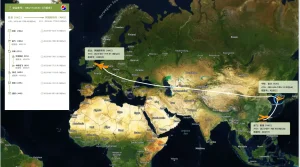
Unpredictability at major global transit points (such as the Panama Canal and Suez Canal) regularly forces ocean carriers to reroute cargo. These dynamic shifts impact vessel capacity and ETA accuracy at West Coast terminals.
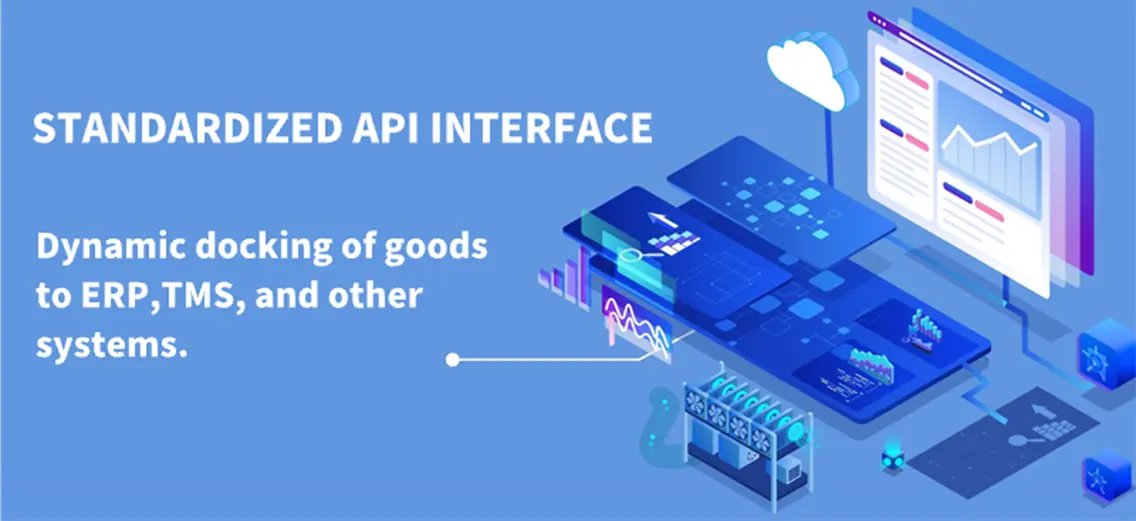
Global procurement divisions now demand structured JSON API formats over manual web portal checks. Modern tracking solutions must integrate directly into existing SAP, Oracle, and customized enterprise resource planning systems.
Recent Federal Maritime Commission (FMC) regulations place strict guidelines on storage billing. To defend against unlawful demurrage fees, shippers must maintain verifiable, independent logs of container discharge times and gate openings.
High-efficiency manufacturing begins at the smart factory floor.
Under China’s Industry 4.0 initiatives, production networks are deeply integrated with outbound logistics pathways. Industrial IoT sensors, smart packaging, and automated cargo handling prepare goods for transport while generating highly accurate initial dispatch data.
Establishing early-stage visibility at manufacturing points in Ningbo, Shanghai, or Shenzhen allows Bay Area importers to anticipate cargo arrivals weeks in advance. When automated assembly networks synchronize with oceanic tracking systems, it eliminates data gaps, facilitating smooth transfers from factory assembly lines to the shipping docks of Northern California.
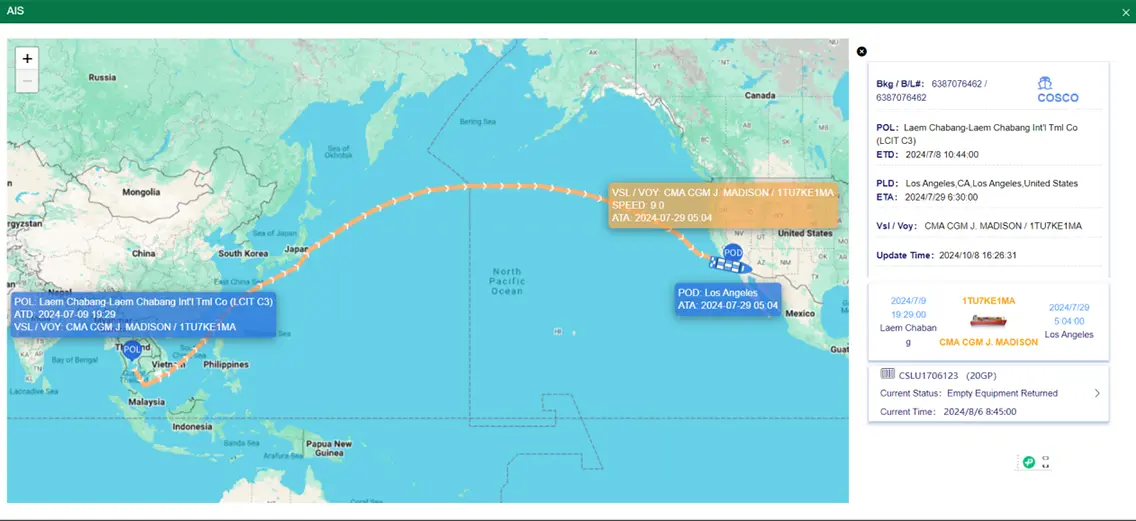
Unlocking true supply chain resilience requires looking past generic carrier updates. By merging global satellite/terrestrial AIS telemetry with port terminal operational schedules, we build an objective record of cargo movements.
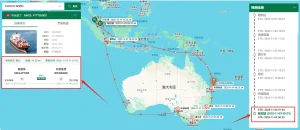
Standard carrier updates often rely on periodic manual reports. Our platform tracks vessel location, velocity, and trajectory directly via satellite and terrestrial AIS receivers, providing reliable coordinates regardless of carrier updates.
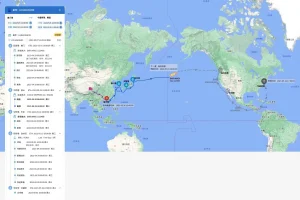
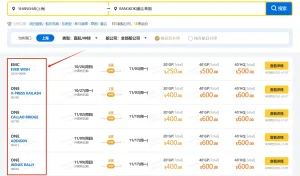
Our sailing schedule APIs automatically cross-reference historical voyages, carrier filings, and congestion metrics to predict delays and identify alternative routing opportunities.
Using historical dwell times and real-time port congestion data, our platform calculates dynamic ETAs, providing logistics teams with highly accurate delivery windows.
Founded in 2015, Trackingeyes is a leading provider of global end-to-end logistics tracking and supply chain visualization solutions.
With a founding team boasting over ten years of logistics expertise, we deeply understand industry pain points. We specialize in global end-to-end cargo tracking by sea and air, serving thousands of import and export enterprises worldwide. Our services include customizable tracking solutions and open API data interfaces to enhance supply chain visibility and operational efficiency.
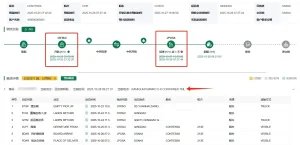
The platform achieves full chain data coverage from the source to the terminal through the collection and aggregation of data sources, including logistics information from various data sources such as stations, terminal, customs, shipping companies, and airlines. Through the Trackingeyes’ Platform, customers can quickly connect with hundreds of global data sources, greatly improving the efficiency and intelligence of logistics tracking.
Through API interface integration, the dynamics of goods can be automatically written back to internal systems and customer service systems of the enterprise, assisting global logistics enterprises, supply chain enterprises, cross-border e-commerce enterprises, software platforms and other enterprises to achieve more efficient and refined goods tracking management, and to do risk control and prediction in advance.
"Unlock end-to-end visibility with our trusted tracking platform. We bring proven reliability to both ocean and air cargo tracking, giving you the accurate data and control needed to streamline operations from port to runway."

See how Northern California businesses leverage Trackingeyes platforms to streamline local operations and reduce logistics costs.
High-value electronics imported from Asian manufacturing hubs require precise arrival coordination at SFO and the Port of Oakland. Real-time updates help local distributors sync warehouse schedules and prevent costly delays.
Wineries exporting temperature-sensitive cargo use automated alerts to coordinate drayage and ensure containers load on scheduled vessels, avoiding exposure to extreme heat at the port.
Exporters of perishable agricultural goods track dynamic port cut-offs and gate openings, helping them adjust shipments to minimize storage costs and preserve product quality.
Find answers to common questions about tracking integration, port operations, and data accuracy on the US West Coast.
The San Francisco Bay Area—specifically the Port of Oakland—often experiences dwell time volatility. Real-time vessel tracking using satellite and terrestrial AIS allows importers to bypass outdated carrier notifications, providing accurate ETAs that help schedule drayage trucks, minimize demurrage fees, and coordinate warehouse labor.
API integrations automate the flow of tracking milestones directly into your ERP (e.g., SAP, Oracle, or Microsoft Dynamics). Instead of manually searching carrier portals, tracking milestones like cargo discharge, customs release, and container gate-out are updated automatically, streamlining operations and reducing administrative overhead.
Cargo pick-up failures usually stem from misaligned carrier ETAs, late customs clearances, and restricted truck appointment windows. Trackingeyes mitigates this by providing real-time alerts on container status changes, customs releases, and gate activity, helping logistics coordinators schedule transport windows within free-time limits.
Air freight tracking operates on much shorter timelines, requiring frequent updates based on flight milestones (e.g., flight departure, touchdown, warehouse handling) using Air Waybill (AWB) status feeds. Ocean tracking focuses on vessel AIS telemetry, transit milestones, and terminal gate events over longer periods.
Automatic Identification System (AIS) tracking provides independent, real-time verification of vessel arrival times, anchoring duration, and port docking times. Shippers can use this telemetry to verify free-time calculations and defend against incorrect demurrage charges billed by carriers or terminals.
Review our comprehensive array of shipment tracking systems, APIs, and analytics packages designed to streamline global supply chains.
Contact our West Coast support team to request a customized tracking integration quote.
Send Inquiry Now Trackingeyes